TL;DR
- A real AI opportunity is frequent, costly, and consistent enough to hand off. A distraction fails at least one of those.
- Most AI projects fail, and usually it's the wrong-problem choice, not weak technology.
- The financial gains from AI are often real but modest, so target work where the cost is real and it repeats.
- Run every idea through five plain questions. If it doesn't clear them, the right move is to not build it.
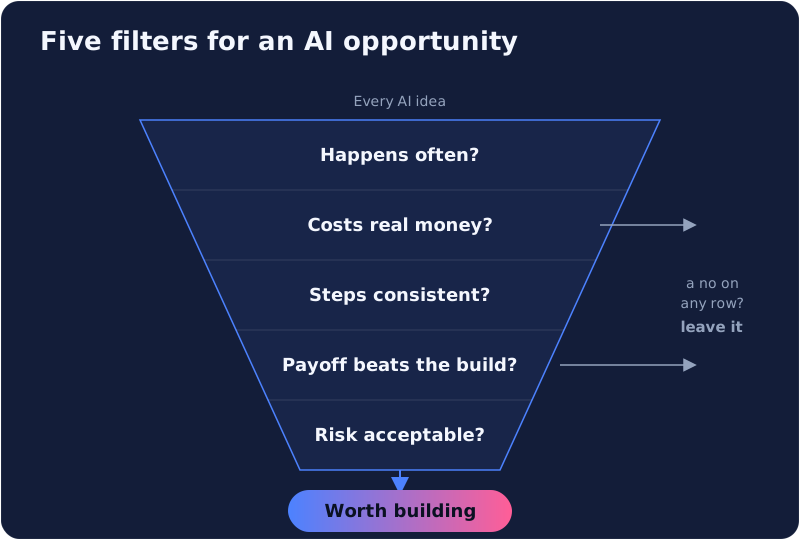
A real AI opportunity earns its place three ways: the work happens often, it costs real time or money, and its steps are consistent enough to hand off. A distraction fails at least one of those tests, usually because it's too rare to matter or leans on judgment no system can replace. Run any idea through five plain questions before you build. The exciting ones rarely clear all five, which is exactly what you want to learn early.
Start with the odds
Most AI projects don't make it. RAND puts the failure rate at more than 80%, roughly twice the rate of IT projects that don't involve AI, and its leading root cause is a mismatch between the project and a real business problem. Harvard Business Review reaches a similar conclusion from a different angle: two Harvard Business School professors argue that most AI initiatives fail not because the models are weak but because organizations aren't built to sustain them. The lesson in both is the same. Picking the right problem, and being ready to run it, matters more than the technology.
That's the job of AI strategy: deciding what's worth building before anyone builds it. Here are the five questions that do most of the sorting.

Does it happen often enough to matter?
AI pays back through repetition. A one-off, however painful, rarely justifies building something to handle it, because the build outlives the problem. The opportunities that compound are the ones baked into the weekly or daily rhythm of the business, where a small saving repeats without end.
Does it actually cost you something?
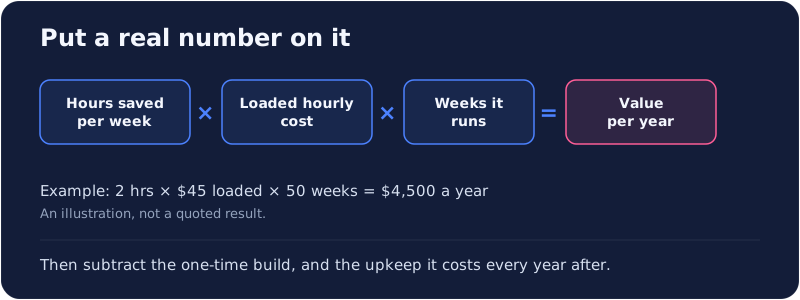
A small cost means a small opportunity, however clever the fix. This is where honesty helps: the financial gains from AI are often real but modest. Stanford's AI Index found that among organizations seeing an impact, most report cost savings under 10% and revenue gains under 5%. Modest percentages still add up on a big, recurring cost, and they vanish on a small one. Chase the work that quietly drains hours or dollars week after week, not the task that's already cheap.
Are the steps consistent enough to hand off?
A system can take over work that runs the same way most of the time. Work that reshapes itself on every pass stays with a person. For the middle ground, several steps with a decision or two mixed in, an AI agent can carry the routine stretch and leave the real calls to people. If the answer here is "it's simple and repetitive," you're likely looking at ordinary automation, and our guide to what to automate first covers how to rank those.
Is the payoff worth the build?
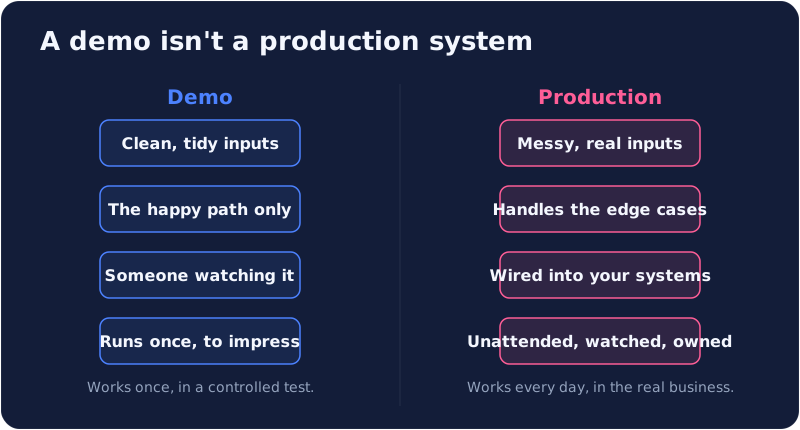
Weigh the return against the effort to get it. A modest win you can ship quickly usually beats a bigger one that drags on for months. Early on, a working system that saves real hours is worth more than a flawless plan, because it makes the next project an easier yes. Be wary of the demo that dazzles in a meeting but touches a task you run twice a month. Impressiveness and value aren't the same thing, and only one of them shows up on the invoice.
What happens when it's wrong?
Every system can make mistakes, and higher-stakes work needs more safeguards, which costs more to build. Price that in from the start rather than finding it halfway through. Knowing the downside up front is part of judging whether the upside justifies it. A misfire in a low-stakes task is a nuisance. The same misfire in billing or compliance is a different conversation, so match the safeguards, and the budget, to the stakes.
Sometimes the answer is no
If an idea doesn't clear these questions, leave it alone. A clear no saves more than a build that never pays for itself, and it costs nothing to reach. We would rather tell you that early than sell you a project that won't earn out.
If you want a second read on your own list, a Free AI Opportunity Assessment runs these questions with you and ranks the ideas that are genuinely worth pursuing.