TL;DR
- The best work to automate first is repetitive, rule-based, and high-volume: the same steps every time, little judgment, lots of reps.
- Rank candidates by how often the work runs and what it costs you. Frequency is what turns a small saving into a real one.
- Leave judgment-heavy work to people. Automate the predictable middle, not the calls that need a human.
- Prove the idea on one clear win before you scale. An early win makes the next project an easy decision.
Automate the work that's repetitive, rule-based, and high-volume. If a task runs the same way every week and swallows hours no one enjoys spending, it's a strong first candidate. Save the hard, high-stakes problem for later, after you've proven the approach on something simpler.
The hard part isn't the technology. It's picking the right first target. Get that wrong and you can spend weeks automating something that barely moved the needle. Here's the order that keeps you honest.
Ask your team what they dread
The fastest signal is the work people would hand off tomorrow if they could. Ask, and the same answers come back: copying data between systems, rebuilding the Monday report, chasing the same follow-ups, cleaning up the same spreadsheet. That dread is a good proxy for repetitive, low-value work, and there's more of it than most owners think. In one survey of knowledge workers, easily-automated tasks ate up an average of 17.3 hours a week, close to half the work week. That's the raw material you're looking for.

Count how often it happens
A task you run once a quarter rarely earns back what it costs to automate, however much it annoys you. One you run every day is a different story. A two-minute job done fifty times a week is worth far more automated than a two-hour job you touch twice a year. Volume is where the money is, so when two candidates compete for first place, the more frequent one usually wins.
Check how much it changes
Automation needs clear rules. The prime targets are the repetitive, rule-based, labor-intensive workflows that go the same way almost every time: filling in forms, moving files between systems, sorting records. Work that calls for fresh judgment on every pass belongs with a person. And when the middle of a task runs several steps with a decision or two along the way, you're at the line between plain automation and something more capable, which is the difference between automation and an AI agent. That line changes what you should build.
Add up what it costs
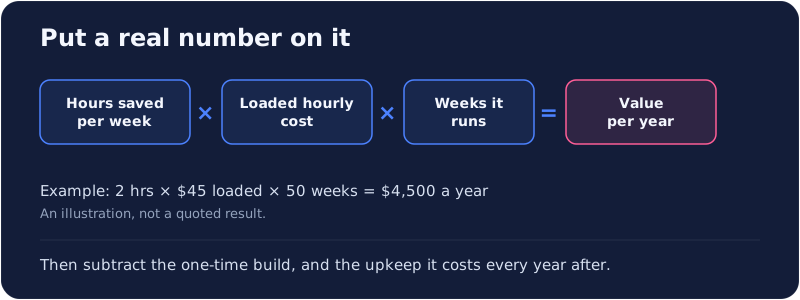
Take a candidate, estimate the hours it burns each week, and multiply by what an hour of that time is worth. Do it across your shortlist and a pattern shows up fast: a handful of tasks account for most of the waste. Putting a real dollar figure on each one does two jobs. It shows you where to start, and it gives you the number you'll measure the finished automation against later. A quick gut check: if you can't roughly say how many hours a task eats each month, it probably isn't frequent or painful enough to lead with.
Rank the list, then build one
Write down your repetitive tasks. For each, note how often it runs, how much judgment it takes, and what it costs. Plot them by frequency against cost, and the top-right corner, frequent and expensive, is where to start.
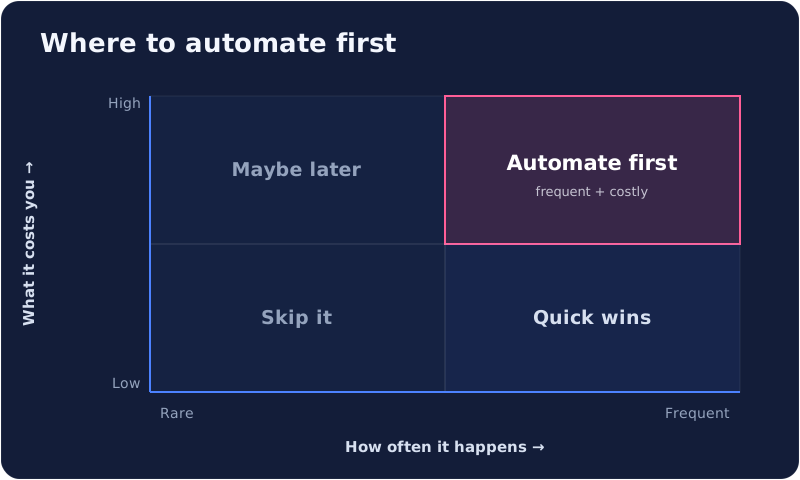
Then build just one. Deloitte's research on scaling automation makes the case: quick wins with high impact and high feasibility build credibility and show value fast. Ship the highest-ranked task first, prove it saves the hours you predicted, and the case for the next one makes itself. That first win is usually a piece of straightforward AI automation, not a moonshot.
The mistake to avoid
Owners often want to point AI at the biggest, most visible problem first. It's the wrong instinct. The flashy problem tends to have the most exceptions, the most judgment, and the least consistent steps, exactly the traits that make automation hard and fragile. The boring, repetitive task you almost overlooked is usually the one that pays back quickly and quietly. Win there, then reach for the hard problem with proof in hand.
If you'd rather not run this exercise alone, a Free AI Opportunity Assessment does it with you: we map your repetitive work, put real numbers on it, and tell you what's worth building first.