TL;DR
- A demo proves an AI can do the task once. Production means it does the task every day, on real inputs, with someone maintaining it.
- Most pilots never cross that gap. An MIT study put the share of enterprise AI pilots with no measurable return at 95%.
- The reason is rarely the model. Pilots stall on weak integration and no one owning the result.
- Build for production from the start instead of scaling a demo later.
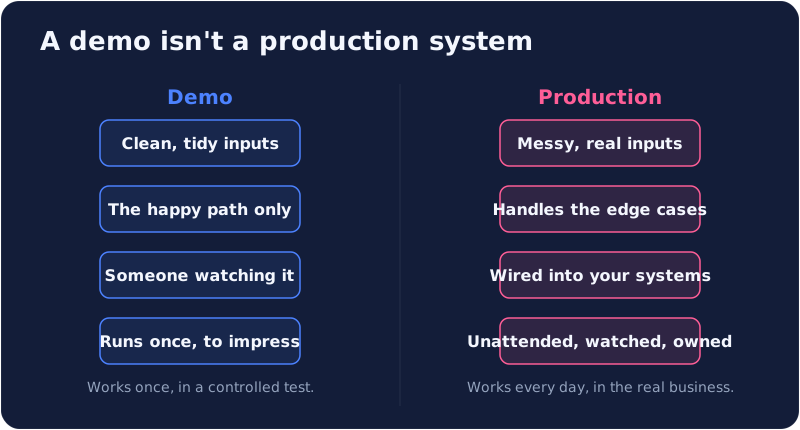
A demo proves an AI can do a task once, in clean conditions, with someone ready to nudge it along. Production means the same task runs every day, on the messy inputs a real business throws at it, without a babysitter. Those are different jobs, and the second is the hard one. Most AI pilots never make the jump.
A demo and a production system are different jobs
In a demo, the inputs are clean and the path is the one the builder chose to show. In production, the inputs are whatever your customers and staff actually type, and the edge cases show up by the thousand. A pilot that shines in a controlled test can fall apart the first week it meets real data. The invoice reader that handled ten sample PDFs cleanly stalls on the vendor who scans pages upside down, and a person is back to clearing exceptions by hand.
MIT Sloan Management Review describes the same split: companies run lots of pilots and prototypes but few production deployments. Most AI work stops at the demo.
The gap is organizational, not technical
When a pilot dies, the instinct is to blame the AI. The evidence points elsewhere. An MIT study of enterprise AI found that 95% of pilots delivered no measurable return, and the cause was integration and fit, not model quality: the tools didn't connect to real workflows and didn't adapt to how the work actually runs. A model that aces a test is still useless if it can't reach your data or nobody owns the result.
The pattern repeats across builds. The data the model needs sits in three systems that don't share it. No one is responsible once the novelty wears off, so small breakages go unfixed. The output lands in a dashboard nobody opens instead of the tool where the work happens. A better model fixes none of that.
What the systems that ship do differently
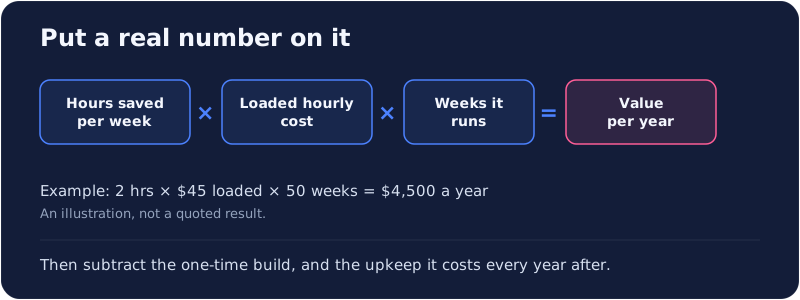
The pilots that reach production share a few plain traits. Each is scoped to one real workflow instead of aimed at everything at once. It plugs into the tools people already use, so the output lands where the work happens. It has an owner who fixes it when the process shifts. And its result gets measured against the number the team started with, the same before-and-after math that tells you an automation paid off.
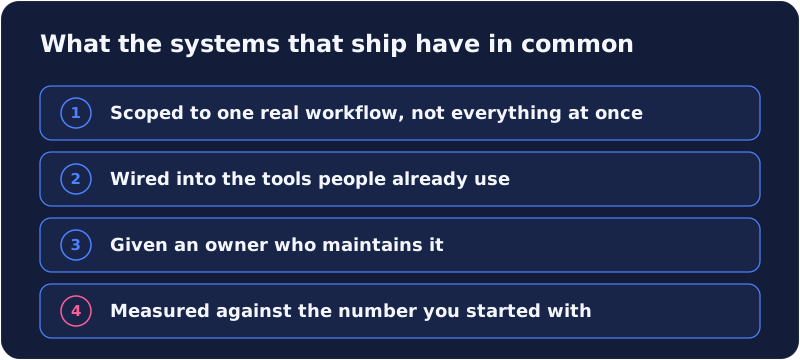
Few teams clear all four. Deloitte's research on AI returns found only one in five organizations qualify as ROI leaders. The rest stay stuck at the pilot stage.
Scope is the trait people resist most. A system aimed at one narrow job, invoice matching, say, can be made reliable, while the same effort spread across a whole department finishes nothing well enough to trust. Ownership gets overlooked most. Tools rot: an API changes or a form grows a new field, and without someone whose job is to notice and fix it, the system degrades until it's abandoned.
Build for production from the start
Stop treating the demo as step one of the real thing. Decide up front how it handles bad inputs and which systems it connects to. Decide who maintains it, and how you'll know it's working. Handling bad inputs means deciding what happens when the system isn't sure, so a wrong guess gets caught instead of flowing downstream unnoticed. That's more work than a quick prototype, and it's the only version that saves anyone time.
Before founding Meridian, our founder built a production AI system that did the work of two people and saved over six figures a year. It wasn't a pilot. It ran on a schedule, handled real work start to finish, and stayed reliable because it was built and maintained for daily use. That experience shaped how Meridian builds, for the day-to-day rather than the demo.
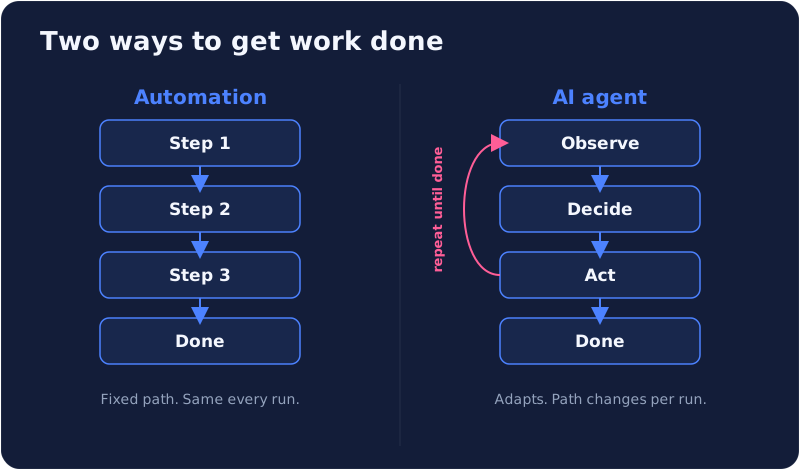
Whether a given workflow is worth building as an automation or a full agent, and whether it clears the bar at all, is the call that AI strategy exists to make. The point is to spend the build budget on work that will still be running a year from now. A demo that impresses a room and then gets shelved has cost you money and taught you nothing.
A Free AI Opportunity Assessment is a straight way to start. We find the workflow that's worth building into production, past the demo stage, and tell you what it would take to get there.