TL;DR
- More of your customers ask an AI assistant before they reach your site. When the assistant doesn't name you, you're invisible at the moment they're deciding.
- AI answer engines cite the businesses whose pages a machine can read without guessing.
- There's no secret file or trick. A page that's clear to a person, marked up so a machine reads it the same way, is what gets cited.
- You can check where you stand today. Ask the assistants the questions your customers ask, and see who they name.
When someone asks ChatGPT or Perplexity about the kind of work you do, the answer names a few businesses and skips the rest. You make that shortlist when a machine can read your site and trust what it finds. There's no trick underneath it. A machine cites what it can read and verify, the same way a careful person would.
More people ask AI before they ask you
The habit has already shifted. 34% of US adults have used ChatGPT, and among adults under 30 that rises to 58%. On the search side, Google now shows an AI-generated answer above the usual links. That answer forms the first impression, before anyone clicks through to a website.
Ranking tenth on a page of blue links was never great, but at least you were on the page. When an assistant replies in a paragraph and cites three sources, being the fourth-best source means you're not in the room. That raises a sharper question than "do we rank." It's whether an assistant names you when someone asks about your kind of work.
What an AI answer engine actually reads
The process is mechanical. A system crawls your pages, works out who you are and how they connect, checks your content against the question someone asked, and cites you when your page answers it cleanly.
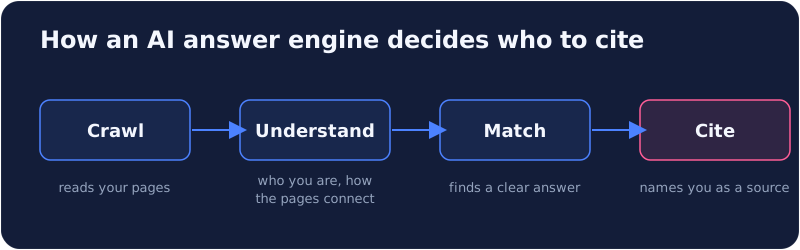
Each step can quietly fail. If your content only loads after JavaScript runs, the crawler sees a blank page. A site that never states plainly what you do and where forces the understand step to guess, and it guesses wrong. Bury the answer four paragraphs down and there's nothing clean to lift. Clear those failures and you turn into the easy source to quote.
The work that makes you citable
For Google's AI features, there's no separate playbook. Google says plainly that the same SEO fundamentals apply, with no AI-specific markup or special files required, and that accurate structured data still helps. The durable work is boring, and it's what has always paid off.
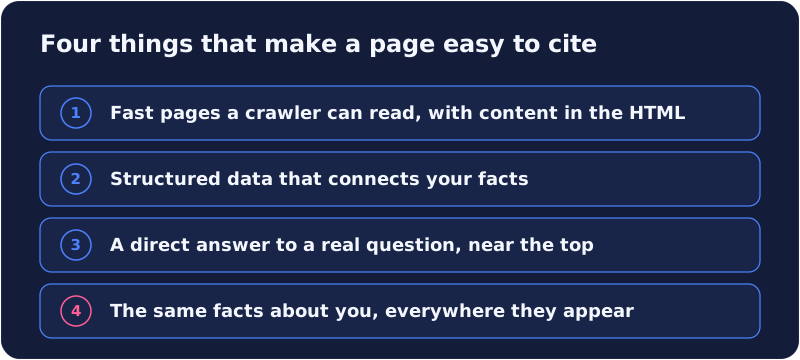
Four things matter most here. The pages have to be fast and crawlable, with the words in the HTML instead of painted on afterward by a script. Your structured data should label what each page means, so a search engine reads your business and your services straight rather than inferring them. Lead with the answer to the question, near the top, phrased the way a customer would ask it. And keep the facts about you identical wherever they appear, because a stale phone number in a directory or an old business name on a forgotten profile makes an engine distrust which version is real. None of this requires a rebuild. Most sites already have the pages, written for a human skim rather than for a machine that has to quote them back.
The AEO tricks you'll get pitched
You'll get pitched a shortcut, usually some file or markup trick that supposedly makes ChatGPT recommend you on command. Be skeptical. Nobody controls which sources an assistant cites, and anyone who promises a guaranteed spot is selling a promise they can't keep. A file like llms.txt, a plain-language summary of what your site does, is cheap to add and some AI systems read it, so it earns its place. It's a small signal that helps at the margin. The real gains come from clarity, applied consistently and measured over time.
AI search optimization sits alongside the rest of the work. It pairs with AI marketing on the broader operation, and with AI strategy so you spend on the parts that actually move results.
How to tell if it's working
You don't have to guess. Open ChatGPT, Perplexity, and a plain Google search, and ask the questions your customers ask: "who's best at X," "how do I handle Y." See whether you're named, and which page gets cited. Different assistants lean on different sources, so a mention in one and a blank in another points straight at the gap. Track what you find, change a short list of things, and look again a few weeks later. It's slow and unglamorous, and it's the only honest way to know whether the work is landing.
If you'd rather not run that audit alone, a Free AI Opportunity Assessment is a straight way to start: we look at how your site reads to search engines and AI assistants today, and tell you what's worth fixing first.