TL;DR
- An automation is worth building when the time it saves over a year, priced at the real cost of that time, clears what it costs to build and maintain.
- How often a task runs matters more than how long it takes. A small job done daily beats a big one you touch twice a year.
- Projects that miss their ROI usually counted the saving and forgot the yearly upkeep, or counted hours that never turned into money.
- Set a payback window before you start. When the math doesn't clear it, the right call is to not build.
An automation pays for itself when the time it saves over a year, priced at the real cost of that time, clears what it cost to build and what it costs to keep running. Most of the math is simple arithmetic. The part people skip is the cost side. Skip it and a build that looked profitable slowly loses money.
Count the hours, then price them honestly
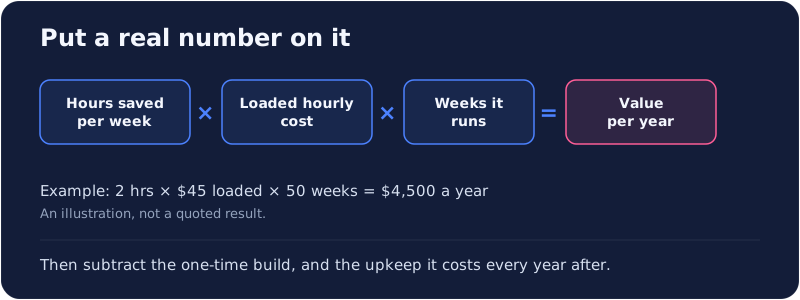
Start with one run of the task. How long does it take a person, and how often does it happen? Two hours a week saved is a hundred hours a year. Price those hours at their fully loaded cost, not the bare wage. Loaded means the salary plus the benefits and overhead stacked on top of it, which lands well above the number on the offer letter. That loaded figure is what the time actually costs you, so it's the number the saving has to beat. Then multiply by how often the work runs. A task saved is worth little when it happens twice a year, and a lot when it happens every morning.
Budget the upkeep, not just the build
Build cost is a one-time number, and it's simple to estimate. Upkeep is the cost teams underestimate, because it recurs for as long as the automation runs. When a form changes or the process shifts underneath it, someone has to fix the automation or it breaks. Budget for that the same way you budgeted the build. The more systems the automation touches, the more upkeep it takes, so a job spanning four tools costs more to keep alive than one that lives in a single app. An automation nobody maintains stops saving as soon as the work changes, and you keep paying to run something that no longer helps.
Deloitte's research on AI returns found only 6% of organizations saw payback within a year, with most use cases taking two to four years. Plain automation pays back faster than AI does. Either way, the return builds over months against real running costs, not on day one.
Put it on a payback timeline
The payback period turns the math into a yes or no. Plot the one-time build cost, then add the net monthly saving until the line crosses zero. That crossing is the month the automation has paid for itself, and everything after it is profit.
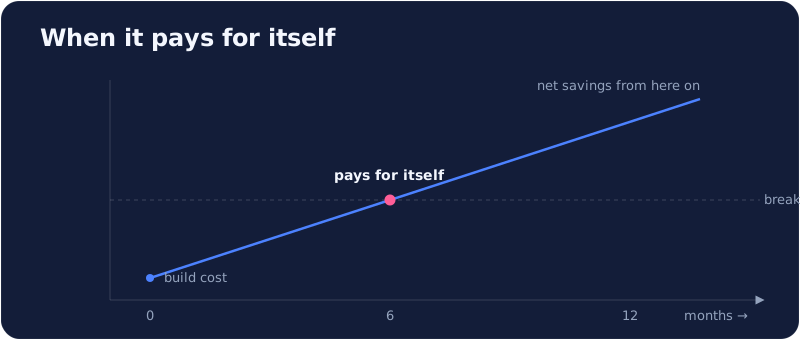
For rule-based AI automation, expect that crossing in months. Deloitte found that organizations which pushed past pilots to scaled automation cut costs by 32%, with payback measured in months rather than years. Decide the window you'd accept before you start. A projected payback of six months is an easy yes. Three years, for a simple task, is a no. A number around a year is a sign to recheck whether you guessed the hours or the frequency too high.
Count only the saving you can bank
Count hours saved only when they turn into money. If an automation frees two hours a week and those hours become idle time, you haven't banked anything. The saving counts only when that time converts into something real, whether that's output you'd otherwise have hired for or a cost you take off the books.
HBR's reporting on AI returns notes that many leaders still struggle to define a clear ROI, which happens when the number was never defined before the build.
Measure it after, against the baseline
Measure the result against what you projected. Write down the before number, the hours or the cost the task carries today, and check the same number once the automation runs. If it hit the projection, you have proof and a template for the next build. If it missed, find out which assumption was wrong before you spend on another one. Run that check after every build, and each automation teaches you how to price the next one.
Choosing which builds clear the bar, and in what order, is what AI strategy is for. It's the same discipline behind knowing what to automate first: price the work honestly, then build the one that pays back fastest.
If you'd rather not build the spreadsheet yourself, a Free AI Opportunity Assessment does it with you. We price your repetitive work at real numbers and tell you which automations clear the bar and which to leave alone.